My AI Forecast: 2027-2034
Making my AI timeline internally consistent across the areas that matter to me
I want to put my money where my mouth is by committing to actual dates and probabilities.
That commitment is harder than it seems once a vague intuition has to become a forecast that can be checked later.
I am putting this out as a statement, or at least evidence, of where my thoughts and timeline actually are right now.
My version is probably a little different from a more general AGI timeline because it has more psychology and clinical-psychology milestones in it. I have generally been on board with the broad direction of AI 2027 and METR’s time-horizon work. I have also been influenced by the AI Futures Project, Plan A, Zvi, and the rest of the AI landscape. I recognize that I am leaning heavily on other people for many of the faster timelines, progress rates, and technical ideas underneath this.
The ledger itself was built in extensive collaboration with GPT-5.6 Sol and Codex, who did much more than take notes. They helped me pull apart compound predictions, define what would count, identify hidden dependencies and bottlenecks, check the probability arithmetic and implied timing, find inconsistencies, preserve the revisions, and turn the whole thing into a structured ledger, timeline, and supporting artifacts. The beliefs, probabilities, and final calls are mine, but the reasoning process and the actual construction of the project received substantial AI help.
My starting estimates were mostly vibes, based on what seemed right or felt right to me. Working through them with Sol and Codex forced those vibes to become definitions, probabilities, dependencies, and dates that at least had to make sense together.
The process clarified my thinking more than I expected, and the most surprising result was AGI landing smack dab in 2030. I thought my own timeline was earlier than that, but even after including my recursive-improvement probabilities, that was where the median landed once the pieces had to fit together.
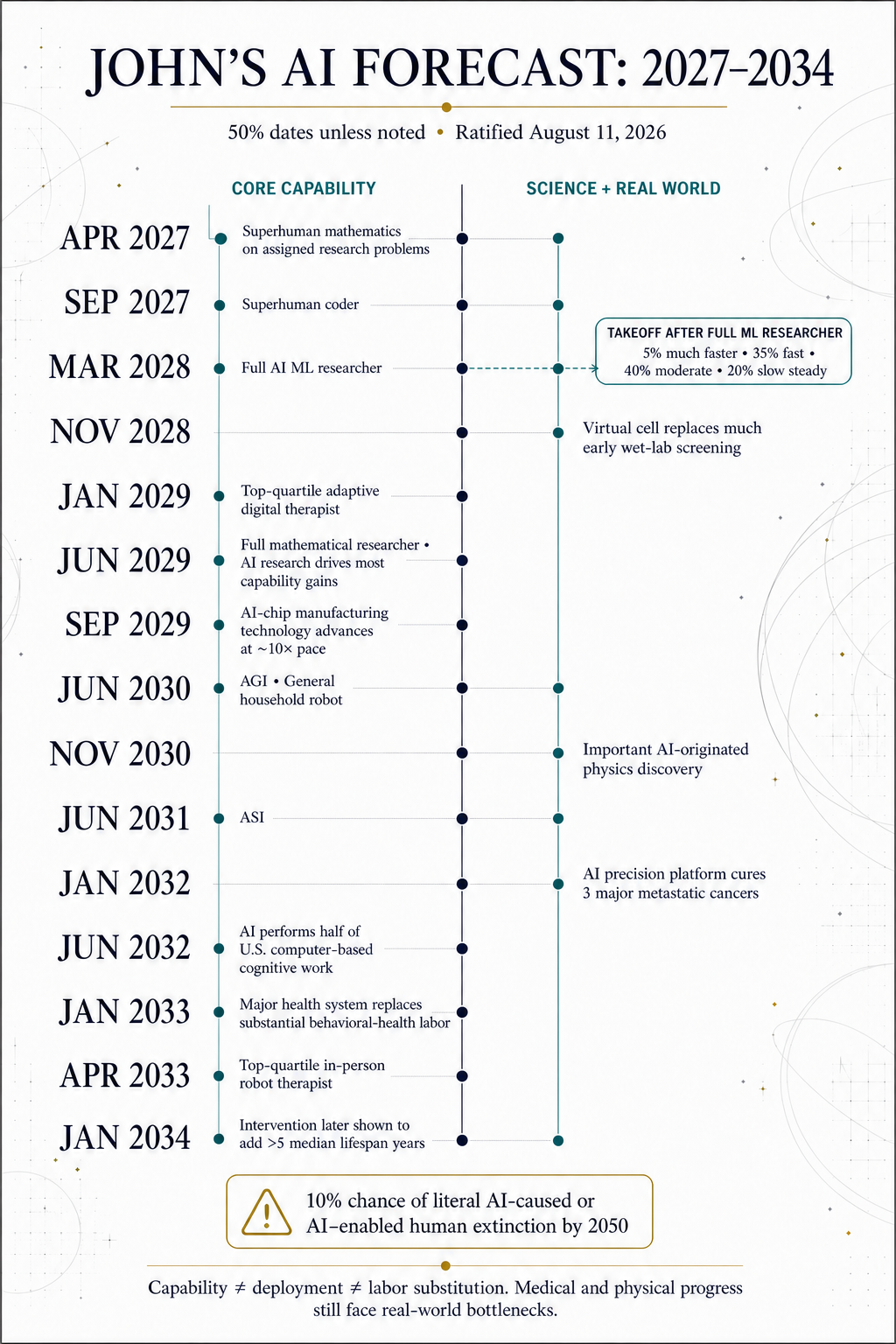
Most of these are my 50% dates, meaning the median of my forecast distribution, with about half of my probability on the thing happening by then and half on it happening later or not happening at all.
The story begins with a superhuman coder in September 2027, then a full AI ML researcher in March 2028. I had been partly equating those two things, and working through the definitions made me separate them.
The coder can do essentially all of the coding work of the best engineers at a frontier AI lab, much faster, including long projects, debugging, error recovery, and work inside large real codebases. But the full ML researcher has to do the whole research loop. It has to come up with hypotheses, choose which experiments are worth running, run them, notice what went wrong, change direction, interpret the results, and communicate what it found. The main gap is research taste and strategy beyond writing code.
The ML researcher is then the trigger for the takeoff part of the forecast.
Conditional on the full AI ML researcher existing, I put 5% on a much faster path that produces around 15 normal model-years of progress in six months, while another 35% goes on the reference fast path. It reaches about 10x normal progress for the first six months and 20x for the second six months. That is around five model-years in the first half and ten more in the second, or 15 years of model progress in one year.
Then I put 40% on a moderate path, with progress at 2x for three months, 3x for three months, and then 5x. The remaining 20% is a slower path that stays around 2x the normal frontier trajectory.
So I take the fast takeoff possibilities very seriously, with 40% of my probability on those paths. Their combined probability still puts the median future in the moderate branch, which is how AGI ended up in June 2030 and ASI in June 2031, even though a large part of my probability remains on something much faster. Before working through the model, I had expected my AGI median to land earlier.
This also helped me separate RSI from ASI, which I had been blurring together more than I realized.
RSI is the feedback loop in which AI becomes good enough at AI research to help build better AI researchers, speeding up the next round. ASI is a separate capability threshold for systems that are substantially better than the best humans across essentially every cognitive domain. RSI can be happening while intelligence is still jagged, with coding and ML research racing ahead while social understanding, strategy, creativity, research taste, or some other domain takes longer.
Once AGI happens, I still put a 70% chance on ASI within one year. Even so, making myself stay consistent pushed my ASI date later than I probably would have said the day before.
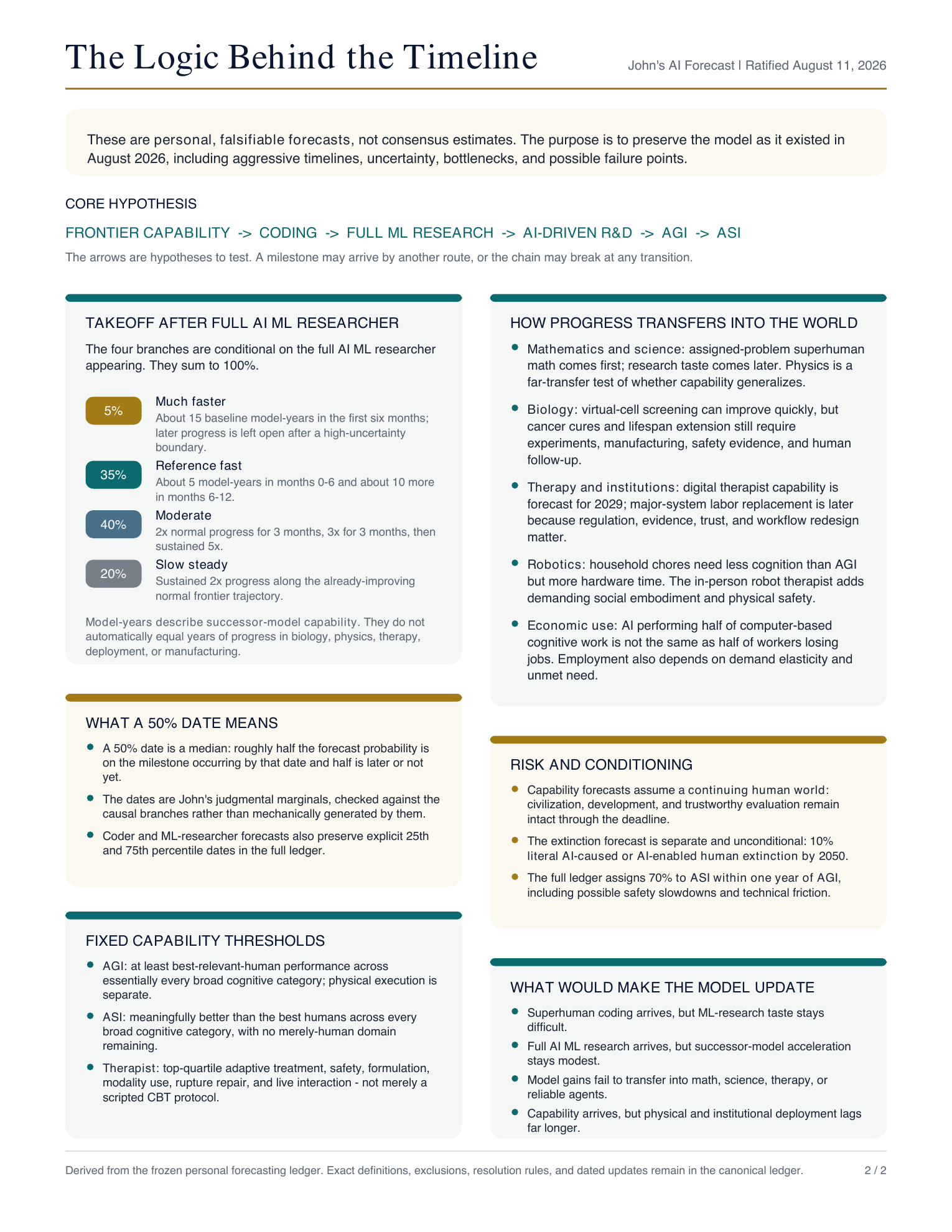
Download the two-page forecast PDF
I also have more psychology and clinical-psychology milestones than most people probably would, for obvious reasons.
One piece I find especially interesting is mathematics, where I have superhuman performance on assigned novel problems arriving very early, in April 2027. A full mathematical researcher comes later because it needs taste and has to choose important questions, create productive concepts or new fields, and decide where to go rather than just solve the problem it was given.
Math could then become a bridge into other fields. One possible route into psychology would be formalizing variables that are currently latent. Instead of a construct being something we infer indirectly and measure imperfectly, a new mathematical framework might define it as an identifiable causal object that supports better predictions and interventions.
That would be radical in both senses, changing how the field works while also being, in the extremely 1990s Ninja Turtles sense, just radical. Parts of psychology could become much more like a hard, verifiable science, possibly with the field reorganized around different and more predictive concepts. Other routes include better black-box prediction, neuroscience, automated experiments, or still-unknown mechanisms. My guess is that several routes could converge on roughly the same capabilities, and the mathematical route is one that currently makes sense to me.
The other big separation involved capability, diffusion, and economic effect, which land on very different timelines.
I put a top-quartile adaptive digital therapist in January 2029. Unless you were told it was AI, it would be indistinguishable in practice from a top-quartile human therapist you might see over Zoom for short-, medium-, or long-term therapy. It would take care of the full therapeutic role, far beyond a scripted CBT protocol. That includes live video, concurrent processing, treatment planning, safety, adapting CBT, ACT, psychodynamic work, or another major therapy as appropriate, responding in the moment, and adjusting across a course of treatment.
I put major health-system labor replacement in January 2033 because capability can arrive before institutions use it, and use can spread before staffing changes follow. Even when AI can do a collection of tasks, job loss depends on whether it can cover the whole bundle, how long implementation takes, regulation and liability, and how much additional demand appears when services become cheaper and easier to provide. A couple of years of diffusion is my rough starting assumption, though the actual economic effect can move around.
Robotics, medicine, and longevity face similar lags, since manufacturing, experiments, clinical evidence, and approval can remain bottlenecks even when cognitive progress is moving extremely quickly.
Finally, I put a 10% chance on literal AI-caused or AI-enabled human extinction by 2050.
The capability dates assume that humans are still around to observe what happens and that civilization is intact enough for development and evaluation to continue, while the 10% extinction forecast is separate and unconditional.
Misalignment seems like a major part of the risk, with “paperclipping” serving as a simplified version of the idea. A system becomes extraordinarily effective at pursuing something that is not actually what humans meant or wanted, and human survival becomes an obstacle or simply irrelevant to the objective.
Very roughly, I think about half of my extinction concern is misalignment or loss of control. The other half is a messier collection of concentrated power, engineered biological weapons, biological accidents, war, and other ways advanced AI could make malicious decisions or ordinary human mistakes catastrophically powerful, although that breakdown is rougher than the capability side.
Ten percent sounds low until you remember that it means one chance in ten of everyone dying, and although alignment may be solvable, our current path gives me little confidence.
The underlying ledger contains full definitions for all of these forecasts, including what counts, the probability, the mechanism, the bottleneck, and how each one should eventually resolve.
The forecasts are now frozen, so if I change my mind later, the old version stays and the update gets a date. Over time, I want to find out whether I was early, late, right for the wrong reason, wrong about the bottleneck, or just completely wrong.
Mostly, though, this was a good exercise because I started with dates and ended up with a model that was more internally consistent than the one in my head, which is what made the process worth doing.
This forecasting project was created in extensive collaboration with GPT-5.6 Sol and Codex, who performed substantive work in eliciting and operationalizing the predictions, mapping dependencies, checking probability and timeline consistency, maintaining the ledger, and creating the written and visual artifacts. Gemini also assisted with editorial revision, while the underlying beliefs, probabilities, timelines, and final decisions remain my own.
Subscribe for future posts
If you want new writing at the intersection of AI and psychology, ethics, and implementation of AI in clinical practice, subscribe on Substack.
The views expressed here are my own and do not necessarily reflect the views of any current or future employer, training site, academic institution, or affiliated organization.